

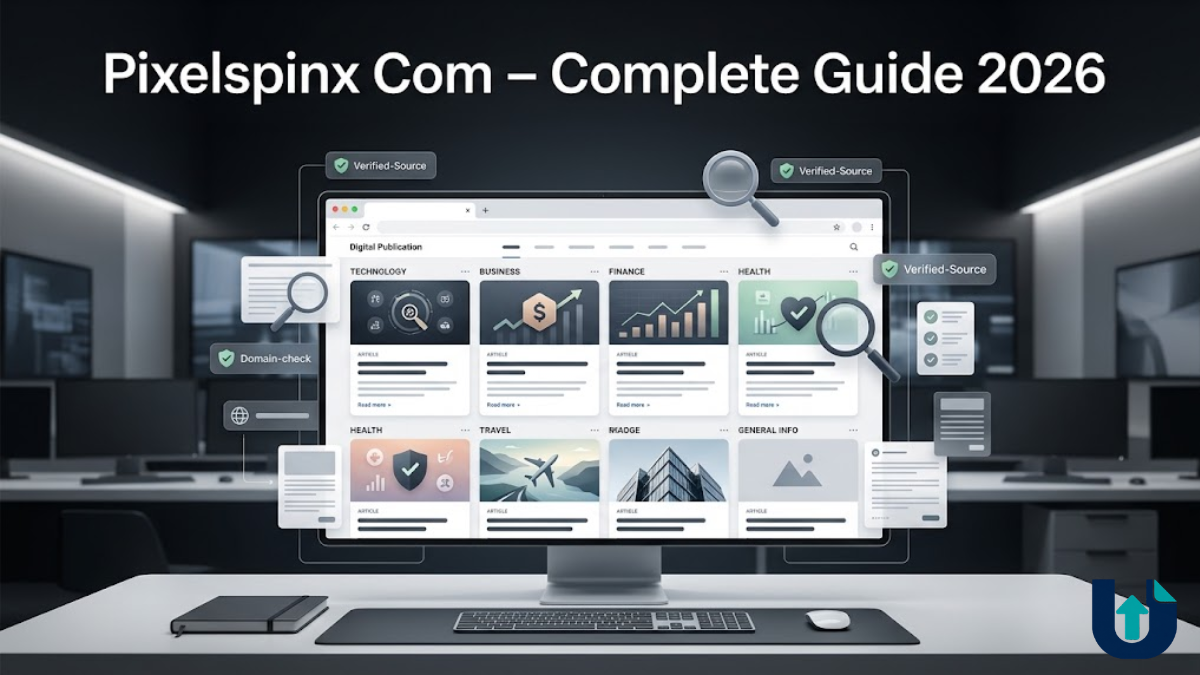
Pixelspinx com has attracted unusual search interest in 2026, partly because online descriptions of the website do not always agree. Some articles label it a creator-focused platform. More detailed reviews describe something simpler: a multi-topic informational publication.
That distinction matters. Readers searching an unfamiliar domain need to know whether they are dealing with a blog, software product, financial service, marketplace, or account-based platform before relying on what appears on the screen.
Current public evidence points toward a general-interest publishing model rather than a self-service creator ecosystem. Recent independent reviews report standard article pages, category navigation and search functions, but no confirmed public creator dashboard, membership program or publishing account system.
What Is Pixelspinx Com?
Pixelspinx com is best understood as a multi-category content website publishing informational articles across subjects such as technology, finance, business, health, travel and general-interest topics.
Recent examinations of the live domain describe it as a WordPress-based publication, rather than software where visitors register, build profiles and publish material independently. Those reviews also report categories including Automotive, Business, Finance, General, Health, Online Game, Technology and Travel.
Basic Information Flow
Search query
↓
Article or category page
↓
Read the published information
↓
Check dates, author details and evidence
↓
Confirm important claims through primary sources
↓
Use the information according to its risk level
The workflow is essentially reader-to-content, not user-to-dashboard.
Why Is Pixelspinx Com Important?
Understanding Pixelspinx com matters less because of its brand name and more because it demonstrates how readers should approach unfamiliar informational websites.
- Search visibility does not establish authority. A page ranking for a query can still require independent verification.
- Broad-topic publishing creates different evidence requirements. A travel idea carries less risk than medical or financial instructions.
- Domain identity matters. Similar-looking domain names can belong to different websites.
- Website type affects expectations. A publication should not be assumed to offer accounts, payouts or software features simply because another article describes it that way.
- Source quality varies by article. A useful page and a weak page can exist on the same domain.
- Transparency becomes more valuable as stakes rise. Readers need stronger sourcing when information could influence health, money or security decisions.
Quick Reference Matrix
| Core Element | Action / What It Involves | Primary Goal / Output |
| Website type | Identify the actual publishing model | Correct expectations |
| Content scope | Review categories and article subjects | Find relevant material |
| Publication date | Check when information appeared | Detect outdated guidance |
| Source trail | Follow references behind factual claims | Establish evidence |
| Author signal | Examine available contributor information | Understand accountability |
| Domain check | Confirm exact spelling before navigating | Avoid lookalike sites |
| Risk level | Match verification effort to the subject | Safer decision-making |
| External confirmation | Compare high-stakes facts with authoritative sources | Reduce factual error |
How to Evaluate the Website Step by Step
The useful question is not simply whether a website “looks legitimate.” A better method separates technical existence, editorial quality and factual reliability.
Step 1: Identify What Kind of Page You Are Reading
Start with the page itself.
A guide, opinion piece, product explanation, news report and commercial landing page serve different purposes. Treating them as interchangeable leads to bad decisions.
- Read the headline without assuming it proves the claim.
- Locate the article category.
- Identify whether the page is educational, promotional or transactional.
- Check whether the writer distinguishes facts from recommendations.
- Note whether a product, company or service benefits from the article.
This first pass tells you what standard of evidence the page needs.
Step 2: Inspect the Publication Date
Online information decays.
Prices change. Software interfaces move. Government rules are revised. Companies rename products. Medical guidance can also be updated.
| Content Type | Freshness Sensitivity |
| Historical background | Low |
| General lifestyle ideas | Moderate |
| Travel logistics | High |
| Software instructions | High |
| Financial products | Very high |
| Health recommendations | Very high |
An old article is not automatically wrong. It simply needs stronger confirmation when the underlying subject changes quickly.
Step 3: Separate Statements From Evidence
Look for claims that can actually be tested.
A sentence such as “this service is popular” is weak without numbers or attribution. A statement tied to an official filing, manufacturer specification, government document or peer-reviewed research gives the reader something concrete to inspect.
For each important claim:
- Identify exactly what is being asserted.
- Look for the source attached to it.
- Open the original evidence when available.
- Check whether the cited material actually supports the sentence.
- Confirm that dates and geographic context match.
Strong research lets the reader trace the chain, not merely trust the writer.
Step 4: Examine the Author Signal
A name alone proves very little.
Useful author information may include relevant professional experience, previous work, subject expertise or a consistent publishing history. Sensitive topics deserve more scrutiny than entertainment or general-interest reading.
Recent public reviews have noted limited transparency around the ownership or editorial leadership of the no-hyphen domain. One review reported no clearly documented founder or detailed editorial team in the publicly visible material it examined.
That does not automatically make individual articles incorrect. It means content should carry more of the evidentiary burden.
Step 5: Check the Technical Domain Signals
Technical information can establish that a domain exists and uses basic web security.
A current third-party domain report lists the exact no-hyphen domain as registered on August 21, 2023, using Cloudflare infrastructure and a valid Let’s Encrypt SSL certificate. The same report says WHOIS identity information is privacy-protected.
These details have limits.
HTTPS protects data in transit. It does not certify journalism, medical expertise, financial accuracy or ownership claims.
Step 6: Verify High-Impact Information Independently
Different subjects require different source hierarchies.
For banking information, use the bank’s official website. For medical guidance, use recognized health authorities or qualified professionals. For software specifications, consult the developer. For laws and government programs, go to the responsible agency.
Treat the general-interest article as discovery material, then move upstream to the source of record.
Industry and Use-Case Specific Scenarios
The value of a general publication changes according to the reader’s purpose.
For Casual Readers
Entertainment, travel inspiration and general-interest explainers can work well for topic discovery.
The reader may only need terminology, background context or ideas for further research. The cost of a minor error is usually lower than it would be in financial or medical content.
For Digital Marketers
Marketers evaluating Pixelspinx com should separate search visibility from editorial reputation.
Useful questions include whether pages are indexed, how topics are organized, whether commercial relationships are disclosed, how outbound references are handled and whether contributed material follows a documented editorial policy.
Those factors reveal more than a single SEO metric.
For Researchers
Researchers should treat broad web publications as secondary discovery sources, not automatic primary evidence.
A page may point toward a company, statistic, event or concept worth investigating. The final citation should normally come from the organization, dataset, paper or document responsible for the original information.
For Consumers Checking an Unfamiliar Brand
A website article can help explain terminology before a purchase.
It should not substitute for manufacturer specifications, verified retailer conditions, warranty documentation or independent testing when money is at stake.
For Publishers Studying Search Trends
The website offers another useful case: brand-query ambiguity.
Numerous 2026 articles have described the domain differently, including claims that it operates as a creator platform. Other reviews explicitly challenged that characterization after finding no public sign-up system, subscription tiers or creator dashboard.
That makes the query a practical example of why publishers should verify an entity before reproducing descriptions from competing articles.
General-Interest Publication vs Specialist Source
| Factor | General-Interest Publication | Specialist / Primary Source |
| Topic breadth | Wide | Narrow |
| Technical depth | Usually moderate | Often detailed |
| Intended reader | Broad audience | Defined professional or customer group |
| Accountability | Publisher-dependent | Institution or expert-dependent |
| Original data | Less common | More common |
| Product specifications | Secondary reporting | Direct documentation |
| Regulatory information | Interpretation | Official text |
| Research value | Discovery and orientation | Evidence and verification |
| Error consequence | Depends on subject | Often better controlled for specialist claims |
| Best role | Starting point | Final confirmation |
Neither format is automatically perfect.
The purpose of the source should match the purpose of the reader.
Common Mistakes and Best Practices
Common Mistakes to Avoid
- Assuming the name reveals the service. “Pixel” can suggest design software or creative tools even when the site functions as a publication.
- Treating HTTPS as an editorial endorsement. Encryption confirms a technical connection, not the correctness of an article.
- Confusing similar domains. The separate pixel-spinx.com domain currently presents itself as a multi-topic publishing site covering Business, Entertainment, Health, Lifestyle, Technology and Travel. A hyphen changes the domain, so readers should not assume common ownership.
- Judging every page from one strong article. Websites can contain material produced by different writers, editors or contributors.
- Assuming hidden WHOIS data proves wrongdoing. Privacy services are used by both legitimate operators and abusive sites. The signal requires context.
- Believing repeated claims because many blogs publish them. Ten articles repeating an unsupported feature do not equal one verified product page.
How to Maximize Efficiency / Best Practices
- Search exact phrases in quotation marks when a claim sounds unusually specific.
- Use date filters for fast-changing software, finance and travel information.
- Save the original source URL when research may need to be reproduced later.
- Classify claims by consequence before deciding how much verification they deserve.
- Prefer named datasets over anonymous statistics.
- Check the destination before entering credentials or personal information.
- Distinguish editorial content from advertisements, partnerships and contributed articles.
- Record the access date when documenting information from changing websites.
Future and Modern Trends
General-content websites are changing because search itself is changing.
AI-generated summaries, answer engines and search-result previews increasingly expose users to information before they open the original page. Publishers therefore need stronger entity clarity, cleaner sourcing and information that can survive being separated from surrounding context.
Search engines also have more signals available than keyword matching alone. Original reporting, identifiable expertise, useful sourcing, coherent site structure and content written for a defined audience all help distinguish substantive publishing from pages created primarily to capture queries.
Broad publications face a particular challenge. Covering ten subjects can generate reach, but expertise does not transfer automatically between fields.
A writer who handles entertainment commentary well is not automatically qualified to interpret clinical research or complex financial regulation.
The likely direction is clear: successful general sites will need to become better at source attribution, contributor transparency, topical quality control and correction processes rather than relying on publication volume alone.
Practical Checklist
Use this checklist when documenting or referencing an unfamiliar informational domain:
- Record the exact domain spelling in your research notes.
- Save the page title and access date.
- Mark statements as observed fact, sourced fact or inference.
- Capture the publication date before quoting time-sensitive material.
- Preserve the original evidence behind important numbers.
- Confirm that quotations have not lost qualifying language.
- Check whether a correction or update notice exists.
- Identify the geographical scope of regulations and prices.
- Keep screenshots when page content may change.
- Avoid making site-wide credibility claims from a single article.
- Document commercial relationships when they affect interpretation.
- Use the original organization as the final reference for consequential claims.
Final Thoughts
Pixelspinx com is most consistently described in current 2026 reporting as a general informational publication, while claims presenting it as a sophisticated creator platform remain poorly supported by the more detailed reviews available today.
The sensible approach is neither automatic trust nor automatic suspicion. Evaluate each page according to its subject, evidence, freshness and consequences, then use authoritative sources when a decision affects health, money, security or legal rights.
Frequently Asked Questions – FAQs
Is Pixelspinx a news website?
It appears closer to a general-interest content publication than a conventional newsroom focused on original breaking-news reporting. Current descriptions emphasize informational articles spanning several unrelated subjects.
How old is the Pixelspinx.com domain?
A current third-party domain report lists its registration date as August 21, 2023. Domain age can provide context, but it does not independently establish editorial quality.
Does Pixelspinx.com have an official mobile app?
No credible public evidence reviewed for this guide establishes an official dedicated iOS or Android application. Readers should verify any app claiming the name through the domain’s own official links before installing it.
Is Pixelspinx.com affiliated with every company it writes about?
Publishing an article about a company does not establish an official relationship. An affiliation should be accepted only when the website or organization explicitly documents it.
Can Pixelspinx articles be cited in academic work?
They may help locate topics or terminology, but academic work usually benefits from citing the original study, official dataset, institutional publication or primary document instead.
Does the website’s SSL certificate prove it is trustworthy?
No. SSL confirms that the connection between a browser and server is encrypted.
It does not verify the truth of articles, professional qualifications, ownership transparency or commercial claims.
Why are there conflicting descriptions of Pixelspinx online?
Multiple recent articles have characterized the domain in different ways. Some describe creator-oriented tools, while others reviewing the visible website report ordinary blog architecture with no confirmed public creator registration or monetization system.
