
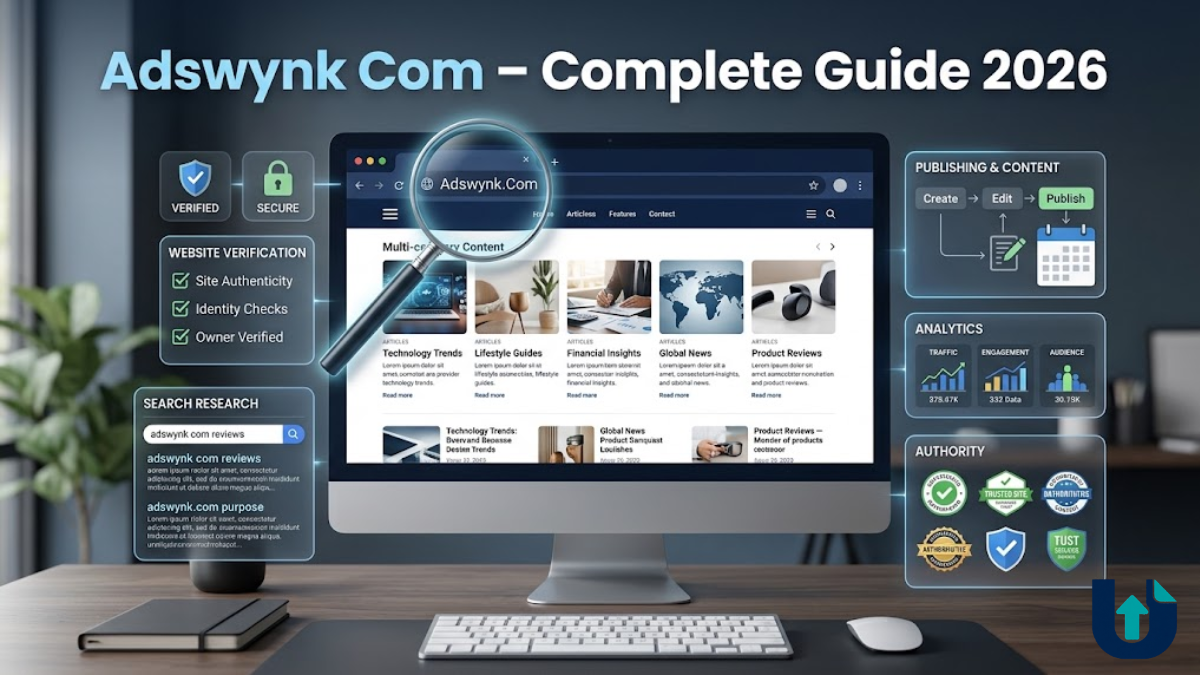
Adswynk com has attracted unusual search interest because online descriptions of the domain do not always match what recent inspections of the website show.
Some third-party articles describe a paid URL-shortening or advertising service. More recent checks, however, identify the live domain primarily as a general WordPress publishing website covering multiple subjects, without visible evidence of a functioning link-shortening dashboard.
That difference matters for readers, marketers, publishers, and anyone researching the domain before clicking links, submitting information, or relying on claims made elsewhere.
What Is Adswynk Com?
Adswynk com currently appears to function primarily as a general-content publishing website rather than a clearly documented advertising network or active paid-link platform.
Recent independent inspection found conventional blog content and WordPress infrastructure. The same assessment reported no visible shortening box, publisher dashboard, or account-creation system associated with the monetized-link model frequently described by other websites.
Quick Website Evaluation Flow
Search result
→ Open current domain
→ Identify visible website function
→ Check whether advertised tools actually exist
→ Review security and ownership signals
→ Compare current evidence with third-party claims
→ Decide how much trust to place in the information
This approach matters because websites change. A description written months or years ago can remain indexed long after a site’s purpose, design, ownership, or functionality has changed.
Why Is Adswynk Com Important?
Interest around the domain is less about one individual website and more about a common internet research problem: search results can preserve claims that no longer match the live destination.
Key reasons the domain deserves careful evaluation include:
- Conflicting descriptions: Search results associate the name with both digital publishing and URL monetization.
- Freshness risk: Older explanations may represent an earlier version of a website rather than its present operation.
- User protection: Visitors should confirm functionality before providing credentials, payment details, or significant traffic.
- SEO research value: Marketers need to know whether a domain is an editorial publisher, advertising service, software product, or something else before evaluating it.
- Brand verification: Similar descriptions copied across multiple websites do not automatically become independent evidence.
- Content accuracy: Writers covering unfamiliar domains should distinguish observed features from claims made by other publishers.
One recent assessment described the domain as a standard blog while explicitly warning that numerous external articles describe functionality that was not visible on the live site.
Quick Reference Matrix
| Core Element | Action / What It Involves | Primary Goal / Output |
| Current identity | Inspect the active domain | Determine present purpose |
| Published content | Review visible categories and posts | Understand editorial scope |
| Feature claims | Look for working tools | Separate fact from description |
| Domain security | Examine HTTPS and reputation data | Identify obvious technical warnings |
| Ownership | Check available business information | Measure transparency |
| External coverage | Compare independent sources | Detect copied or outdated claims |
| User interaction | Inspect forms and account features | Understand data exposure |
| Freshness | Check publication and scan dates | Avoid obsolete conclusions |
Step-by-Step Deep Dive
Step 1: Establish What the Website Does Today
Start with the active website rather than a third-party review.
A website’s current interface is primary evidence for what visitors can actually use. If a platform is described as offering software functionality, the expected interface should normally contain visible ways to access that service.
Check for:
- Main navigation.
- Homepage purpose.
- Article categories.
- Registration options.
- Login areas.
- Interactive tools.
- Pricing or publisher documentation.
- Terms connected to the claimed service.
Recent September 2026 research described the domain as carrying general editorial material across areas such as technology, finance, education, health, lifestyle, travel, and digital topics.
Step 2: Separate Editorial Content From Software Functionality
A website discussing online income does not automatically provide an online-income service.
Look at what users can actually perform, not merely what articles discuss.
| Evidence | What It Can Demonstrate |
| Blog post | Editorial coverage |
| Working dashboard | Operational software |
| Registration system | User-account capability |
| Functional URL generator | Link-shortening capability |
| Advertiser console | Campaign-management capability |
| Publisher analytics | Monetization infrastructure |
| Documentation | Defined product operation |
This distinction is particularly important here because several web pages characterize AdsWynk.com as a monetized URL platform, while recent live-site checks report that such functionality is absent.
Step 3: Date Every Claim
Internet research becomes unreliable when dates disappear.
Record three separate dates whenever possible:
- When the source was published.
- When the source actually inspected the domain.
- When you performed your own check.
A page published recently can still repeat information taken from an older source.
Freshness carries more weight when the writer explicitly states that the current website was inspected. One September 2026 report, for example, compared circulating monetization claims against the live domain and concluded that the active site behaved mainly like a general publisher.
Step 4: Inspect Technical Trust Signals Carefully
Technical security indicators answer limited questions.
HTTPS confirms encrypted communication between a browser and server. It does not prove that every business claim on a website is accurate.
Useful signals include:
| Signal | What It Tells You |
| TLS/HTTPS | Connection encryption |
| Domain age | How long the domain has existed |
| DNS reputation | Known infrastructure warnings |
| Malware databases | Recorded security detections |
| Redirect behavior | Where visitors are actually sent |
| Hosting information | Technical infrastructure |
| Browser warnings | Immediate access concerns |
A recent security assessment assigned the site a 72/100 low-risk assessment, while also noting conflicting third-party descriptions and one historical antivirus signal. The same report said the domain was registered in June 2023. These findings should be treated as individual technical indicators rather than a blanket guarantee of safety.
Step 5: Investigate Ownership and Accountability
A legitimate website does not necessarily publish the owner’s personal identity. Privacy-protected registration is common.
Still, commercial services become easier to evaluate when users can find clear organizational accountability.
Look for:
- Registered company details where applicable.
- Business contact information.
- Editorial ownership.
- Terms of service.
- Privacy disclosures.
- Refund or payment policies when money is involved.
- Named support channels.
ScamAdviser reports that the WHOIS identity connected with this domain is hidden, while also noting a valid SSL certificate and other technical signals. Hidden WHOIS data alone does not establish fraudulent activity.
Step 6: Test Revenue Claims Against Verifiable Evidence
Claims involving earnings deserve a much higher evidence threshold than ordinary blog information.
For an active monetization platform, strong evidence would normally include current publisher documentation, payment rules, supported countries, minimum withdrawals, account functionality, and verifiable transaction records.
Do not substitute screenshots from unrelated websites for primary evidence.
Several reviews repeat claims that users can shorten URLs and earn from advertisements. Other recent examinations could not independently verify the corresponding tools or current payment operation.
Step 7: Evaluate Individual Articles Separately
A domain-level reputation score cannot tell you whether a particular article is correct.
Judge each page using its own evidence.
Look for:
- Named sources.
- Specific dates.
- Author information.
- Direct references.
- Original analysis.
- Correctly attributed statistics.
- Updated information when the subject changes rapidly.
General publishing sites can contain strong and weak pages at the same time. Page-level verification remains necessary.
Industry / Use-Case Specific Scenarios
Adswynk Com for Casual Readers
A casual visitor may arrive through Google while researching technology, finance, lifestyle, health, travel, or another general topic.
The relevant question is simple: Does the individual article support what it claims?
Readers should focus on source quality, publication date, author transparency, and whether factual statements can be confirmed elsewhere.
For SEO Professionals
SEO specialists have a different task.
Before considering a website for outreach, mentions, link placements, or competitive analysis, examine:
- Organic topic consistency.
- Indexation.
- Recent publishing activity.
- Existing outbound-link patterns.
- Article quality.
- Author pages.
- Editorial disclosures.
- Relevance to the target campaign.
A broad-content domain can rank for many unrelated terms, but topical relevance should still be assessed at the page and section level.
For Advertisers
Advertisers should not infer advertising capabilities from the site’s name.
A genuine advertising opportunity should provide concrete information about inventory, audience, placement type, reporting, pricing, targeting, and contact procedures.
Without those elements, treat advertising claims as unverified until the publisher confirms them directly.
For Publishers Researching Competitors
Publishers can use the domain as an example of why brand identity and topical positioning need consistency.
When search engines find radically different descriptions of the same entity, users receive fragmented expectations. Clear About pages, accurate metadata, structured data, and stable positioning reduce that confusion.
For Researchers and Journalists
The biggest lesson is evidentiary.
Never convert widespread repetition into confirmation.
Ten pages repeating one unsupported description may still represent one original claim copied nine times.
Direct Comparison Matrix: Search-Result Claims vs Evidence-Based Verification
| Factor | Search-Result Assumption | Evidence-Based Verification |
| Source selection | Relies on ranking position | Prioritizes direct evidence |
| Time sensitivity | May ignore publication age | Records inspection date |
| Repeated claims | Can appear authoritative | Traces origin of claim |
| Product features | Accepts written descriptions | Requires observable function |
| Revenue claims | Trusts stated rates | Seeks documented payment evidence |
| Security | Uses one trust badge | Reviews multiple independent signals |
| Ownership | Assumes brand identity | Checks accountable entities |
| Decision quality | Fast but uncertain | Slower but defensible |
Common Mistakes & Best Practices
Common Mistakes to Avoid
- Treating every Google result as equally reliable. Ranking does not establish factual accuracy.
- Assuming a domain name explains the business model. Branding can survive long after a site’s purpose changes.
- Using HTTPS as proof of legitimacy. Encryption protects transmission, not truthfulness.
- Quoting earnings figures without dated documentation. CPM rates, minimum payouts, and supported countries can change quickly.
- Confusing domain age with business continuity. A domain can remain registered while its content or operators change.
- Relying on AI-generated summaries without opening sources. Summaries may merge conflicting descriptions into one false narrative.
- Entering sensitive information before confirming the service. Credentials and payment information deserve stronger verification than ordinary browsing.
How to Maximize Efficiency / Best Practices
- Search exact feature names rather than only the brand.
- Use quotation marks when tracing repeated wording across publishers.
- Archive important evidence when performing professional research.
- Check footer pages for operational details that homepage copy may omit.
- Compare several security databases instead of treating one score as definitive.
- Inspect destination URLs before following unfamiliar shortened links.
- Separate observed facts from reported claims in your own notes.
- Record uncertainty explicitly rather than filling evidence gaps with assumptions.
- Recheck changing services periodically when decisions depend on current functionality.
Future & Modern Trends
Website verification is becoming more difficult because AI-generated search summaries can combine information from multiple generations of a website.
A service may begin as one product, disappear, relaunch as a publisher, change ownership, or preserve the same domain while completely changing its purpose. Search indexes do not always update every associated description at the same speed.
Entity consistency will therefore become more valuable.
Websites that want a clear identity will increasingly need structured organization data, detailed About pages, transparent authorship, updated policy pages, consistent social profiles, and accurate service documentation.
Browser security systems are evolving too.
Modern reputation products increasingly combine domain history, redirects, malware feeds, infrastructure data, reputation databases, and page behavior rather than relying on a single blacklist.
Content publishers face another shift: source provenance.
Search engines and readers increasingly reward pages that show where information originated, when it was checked, and what remains uncertain. Thin articles that simply recycle another site’s description become easier to identify when conflicting versions spread across the web.
For adswynk com, that trend is especially relevant because its search footprint currently contains competing descriptions of what the website represents.
Practical Checklist
Use this checklist before relying on information from an unfamiliar website:
- The page shows a visible publication or update date.
- Major factual claims link to identifiable evidence.
- Author information can be located.
- Contact details match the site’s stated purpose.
- Privacy information explains data collection.
- Commercial claims have supporting documentation.
- External links lead where their anchor text suggests.
- Downloads come from expected domains.
- Browser security warnings are absent.
- Important information is corroborated independently.
- Financial promises include clear terms.
- The site’s current interface matches its advertised function.
- Reputation reports are recent enough to matter.
- Conflicting evidence is acknowledged instead of hidden.
Final Thoughts
Adswynk com is best understood through current evidence rather than the descriptions repeated around it. Recent checks point toward a general publishing website, while the widely circulated paid-link-shortener narrative remains difficult to verify against the present live interface.
The broader lesson applies far beyond one domain. Check the website that exists today, date the evidence, verify functional claims, and keep uncertainty visible. That produces a more reliable conclusion than repeating whatever description appears most often in search results.
Frequently Asked Questions – FAQs
Is Adswynk.com currently a link-shortening platform?
Recent inspections did not identify a working URL-shortening interface, publisher dashboard, or associated account system on the live domain. Several external articles still describe such a service, creating a clear conflict between third-party claims and current observations.
Can users currently make money from AdsWynk.com?
There is insufficient current primary evidence to confirm an operational earning program. Public claims about paid clicks should therefore be treated as unverified unless the live website provides working publisher tools and current payment documentation.
Is the website automatically unsafe because its WHOIS information is private?
No. WHOIS privacy is used by many legitimate domain owners to reduce spam and unwanted contact.
It is simply one transparency signal, not proof of either legitimacy or fraud.
How old is the domain?
A September 2026 security report lists the domain’s registration date as June 2, 2023, making it more than three years old at the time of that assessment. Domain age provides historical context but does not verify every current service claim.
Why do websites describe AdsWynk differently?
Descriptions can diverge when a domain changes purpose, old information remains indexed, or later writers repeat earlier reports without confirming the live product.
That appears to be the central issue behind adswynk com search results in 2026.
Does a valid SSL certificate mean the site can be trusted completely?
No. SSL encrypts data transferred between the browser and website.
A certificate does not authenticate article accuracy, payment promises, business ownership, or editorial quality.
What should I verify before submitting personal information?
Confirm the purpose of the form, privacy policy, domain name, data requested, and identity of the party receiving it.
For financial information or passwords, use a substantially higher verification threshold than you would for simply reading an article.
